Why TAPPaaS
Let's start with a simple question: who is actually in control of your digital life?
- Your data — where it lives, who can read it, whose law applies to it.
- Your costs — the cloud bill that only ever goes up.
- Your access — whether you could still reach your own systems if a provider, a policy, or a geopolitical decision changed tomorrow.
For most organisations the honest answer is: someone else. We've traded control for convenience — and in a world that is getting less stable, not more, that trade is starting to look expensive.
The cloud is a continuum — and there's a glass wall
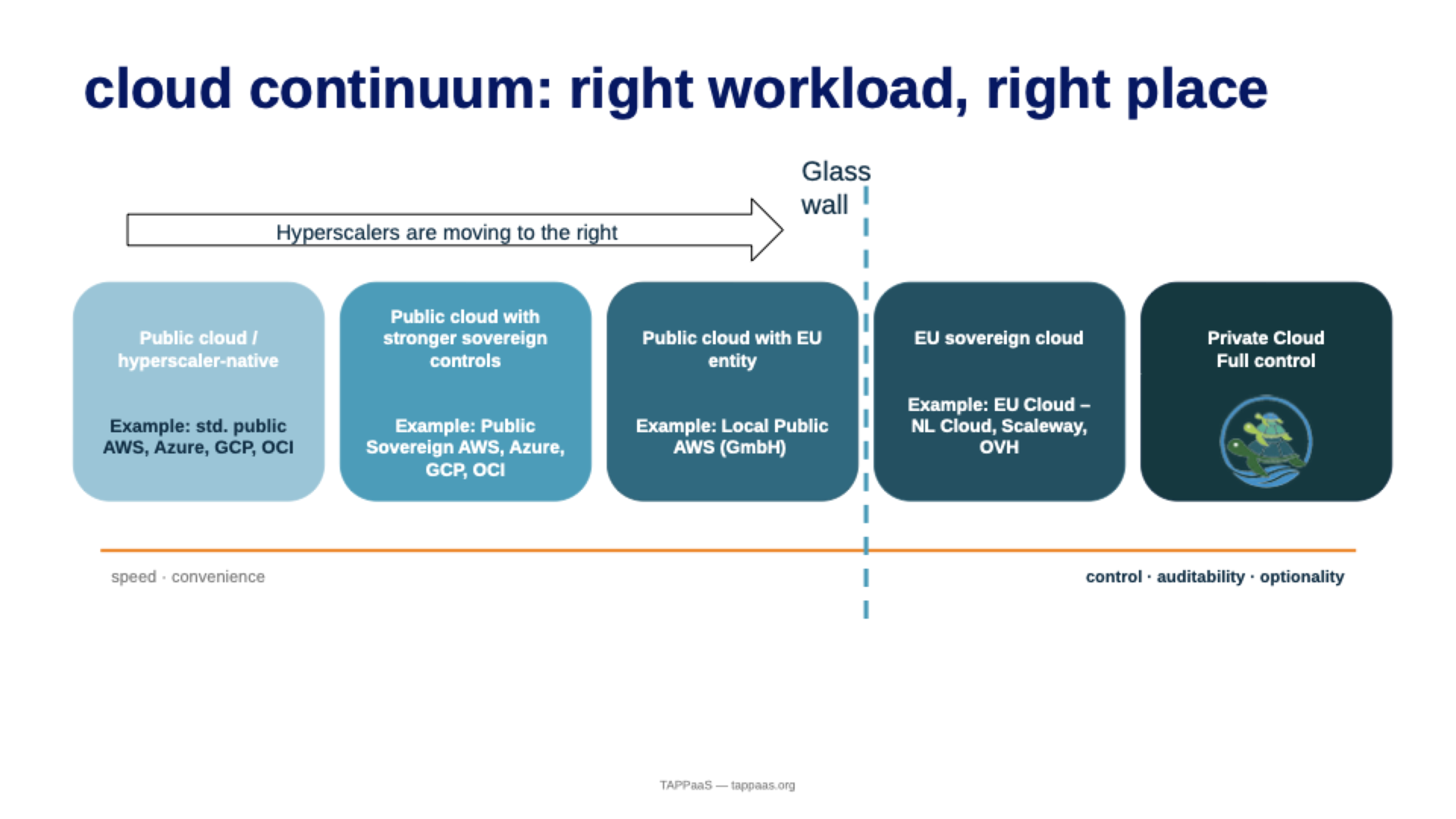
The cloud isn't one thing — it's a continuum. On the left, the public hyperscalers: fast, convenient, and outside your control. Moving right you gain sovereignty — sovereign controls, EU entities, EU clouds — and at the far end, private cloud: your hardware, your premises, your jurisdiction.
Notice the glass wall. The hyperscalers know sovereignty matters — they are all moving right, adding "sovereign" offerings. But they can never cross that wall: as long as your infrastructure is owned and operated under someone else's jurisdiction, your sovereignty is a promise in a contract — not a fact of architecture.
And this isn't only about jurisdiction. It's about resilience. On the right side of the wall your systems keep running even if the connection to the outside world doesn't: connected to the internet, but not dependent on it.
So if the right side is where control and resilience live… why isn't everyone there already?
The hurdle: what a cloud really is
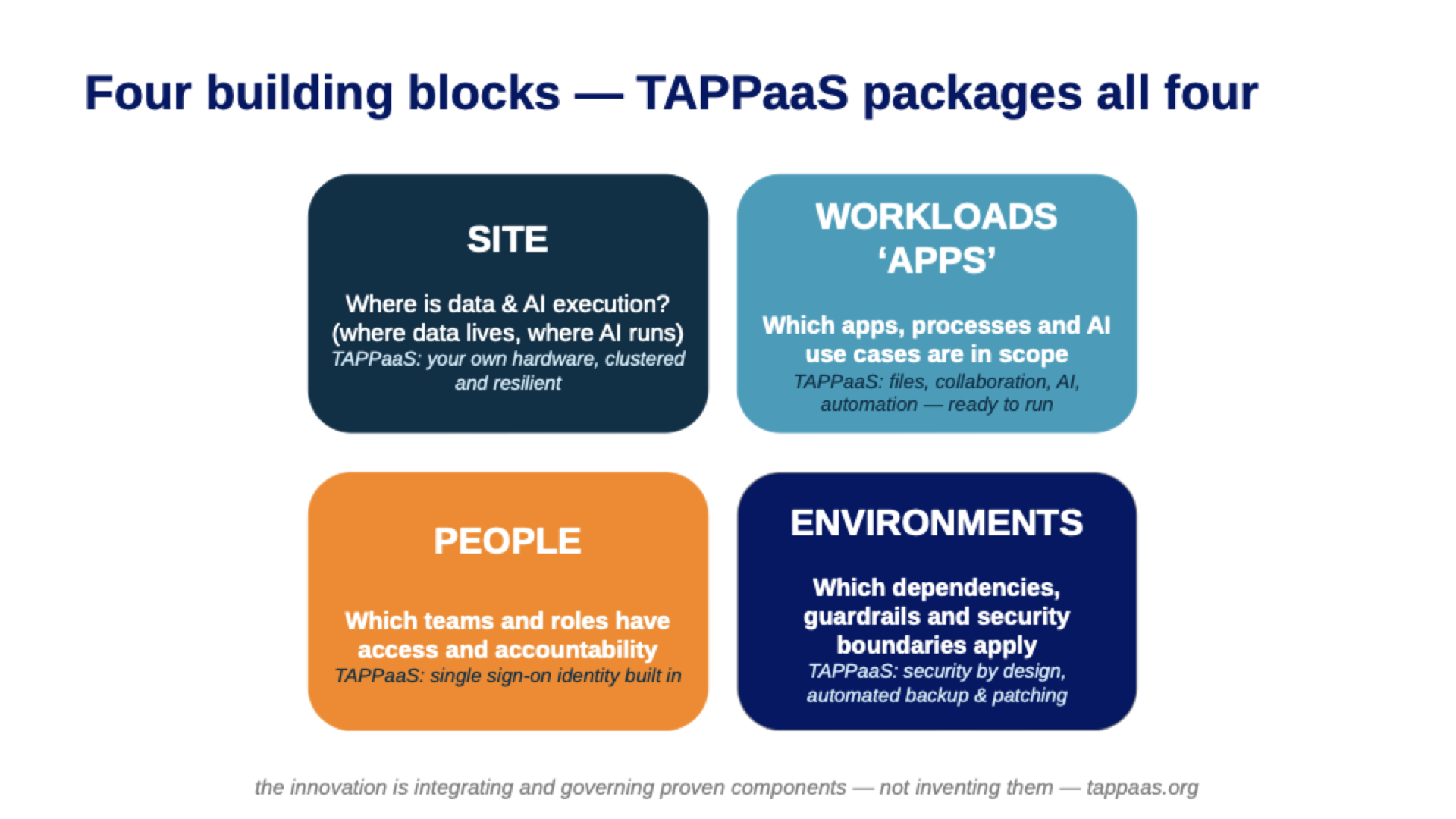
Here's the uncomfortable truth: the hyperscalers earned their position. Their real product was never servers — it was packaging. They took hundreds of complicated services and wrapped them into something easy, robust and automated.
Because a real cloud platform comes down to four building blocks:
- Site — where your data lives and your AI runs: cluster, storage, network, firewall.
- Workloads — the applications your organisation actually uses: files, collaboration, automation, AI.
- People — identity, sign-on, who has access to what.
- Environments — the security boundaries, the backup, the patching, the guardrails.
If you wanted to self-host all of that yourself, you would have to become your own cloud provider: integrate dozens of open-source components, keep them secure, patched and backed up. That is the hurdle — and why organisations that want sovereignty still end up on the left side of the glass wall.
TAPPaaS removes that hurdle. It packages the entire thing — all four building blocks, pre-integrated, automated and open source. The innovation isn't inventing new components; it's curating, integrating and automating proven ones — so self-hosting feels like the cloud:
| Principle | What it means |
|---|---|
| Curation | Opinionated selection of mature, actively-maintained FOSS — fewer choices, better fits |
| Integration | Components configured to work as one platform: identity, network, backup, ingress |
| Automation | Install, patching, and backup handled by the platform — not by hand |
The same four blocks, all the way down
The four building blocks aren't just marketing: they are the platform's actual architectural taxonomy (in the technical docs: Site · Apps · People · Environments). The Architecture section is the same model in full technical depth.
The vision: Trusted · Automated · Private
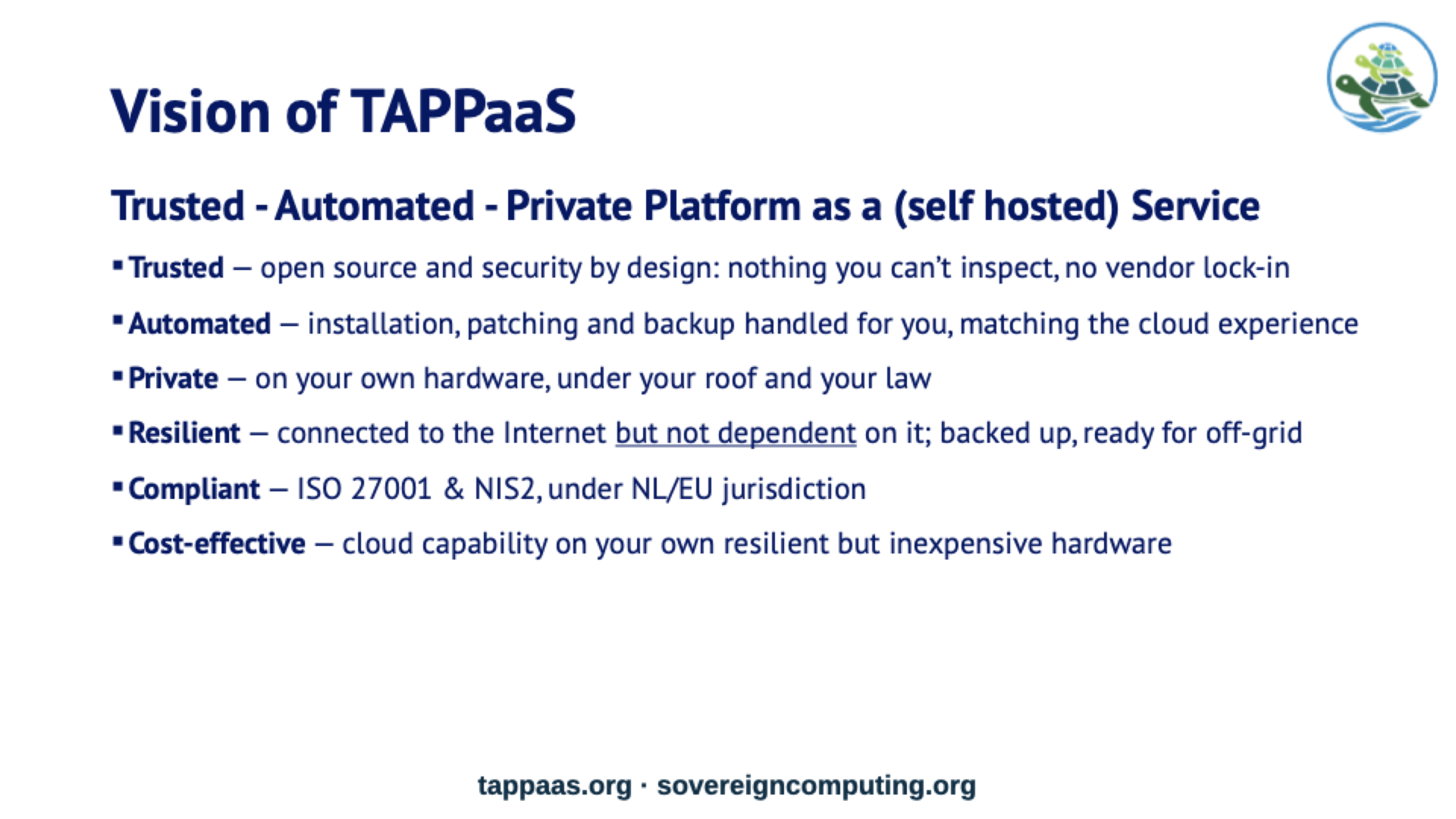
TAPPaaS stands for Trusted, Automated, Private Platform as a Service — self-hosted.
- Trusted — security by design and fully open source (MPL 2.0): nothing you can't inspect, no vendor that can lock you in.
- Automated — installation, patching and backup are handled for you, matching the cloud experience instead of fighting it.
- Private — it runs on your own inexpensive hardware, under your roof and your law — which also makes it remarkably cost-effective.
And resilient by design: backed up, and ready to run off-grid when it has to.
This isn't a slide-deck vision. TAPPaaS is running today — serving files, running AI models locally, automating workflows — with its first adopters.
Who is it for?
TAPPaaS serves those who need digital independence but not a dedicated IT department:
- Small and medium businesses — reliable office infrastructure on hardware you own, without the ever-growing subscription stack.
- Governments, NGOs and critical-infrastructure providers — systems that must obey local law and keep working when connectivity doesn't.
- Communities of homes — shared, self-governed digital services for a neighbourhood, cooperative or association.
- Technically-capable households — family photos, documents and automation under your own roof.
Platform Democracy
TAPPaaS is built on the principle that producers are also consumers of the system: we use what we build, and we build what we need. All of it Free and Open Source Software — no proprietary dependencies, mobile-accessible, and offline-capable.
Go deeper
- Design Principles — the seven rules everything is built by, and what TAPPaaS deliberately is not.
- Digital Sovereignty — what sovereignty means, in plain terms.
- Examples — what people actually run on TAPPaaS today.
- Install TAPPaaS — choose hardware and bootstrap your platform.
- Architecture — how the four building blocks are built.