Security design
A high security standard is essential for TAPPaaS to compete with cloud providers. TAPPaaS addresses security across seven areas:
- Secrets and password management
- Root and management access to virtual machines
- Network segmentation
- Inbound internet access security
- Supply chain security
- Monitoring of the TAPPaaS solution
- Resiliency in case of breach
Secrets and password management
A trusted, self-hostable password manager is essential; the choice is Bitwarden/VaultWarden — a Rust reimplementation of the Bitwarden server, audited, and the only true open-source self-hostable option. The same vault also holds integration secrets, which simplifies setup.
The server runs behind the TAPPaaS reverse proxy, so it is reachable everywhere; secrets are stored encrypted, so even a server compromise does not expose the passwords.
VaultWarden complements the Authentik SSO provided by the identity foundation module — together they form the complete TAPPaaS identity and credential strategy:
- Authentik (
identity) manages single sign-on for every application that supports it (OIDC or forward-auth). - VaultWarden (
vaultwarden) securely stores credentials for legacy systems and external services that cannot yet use SSO.
Root and management access to VMs
- Management is performed either from the root account of the TAPPaaS node itself, or from the
tappaasaccount on thetappaas-cicdVM. - Every VM has a
tappaasuser withsudorights; the cloud-inittappaasuser has no password login, and root has no password login. - An SSH authorized-keys allow-list permits login only from
tappaas@tappaas-cicdand from root on the TAPPaaS node.
Public administrative access with no public IP is delivered by the satellite admin-vpn role — see satellite.
Network segmentation
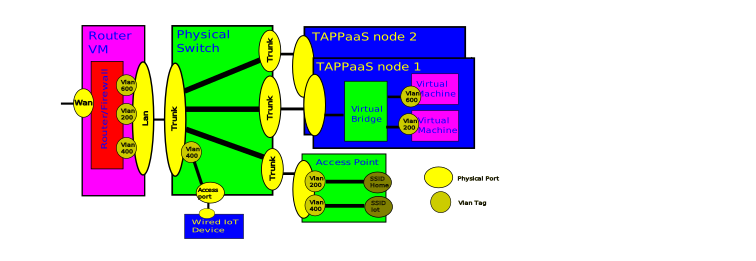
TAPPaaS segments the network into security zones so that a breach of one service or VM does not immediately reach the others. The zone model — trust tiers, the isolation invariant, and the VLAN bands — is the network module's design, with the operational definitions the single source of truth in Network Zones. VLAN tags map to zones by band — Service 2xx, IoT 4xx, DMZ 6xx (management is untagged):
Inbound internet access security
External access is controlled by three components:
- A reverse proxy with access control — Caddy terminating TLS on the OPNsense firewall (the
networknetwork:proxycapability). For sites without a public IP, thesatelliteblind reverse-proxy publishes services over a WireGuard tunnel (ADR-010). - A blocking firewall filtering DNS and IPs against public block lists (Unbound DNSBL).
- Participation in the CrowdSec network (planned).
Supply chain security
- Use software only from major open-source organisations with a good security history.
- Monitor CVE publications across all TAPPaaS packages.
- Keep software patched weekly (automated).
Monitoring
Observability is delivered by the Health lens — the logging foundation module (Loki / Grafana / Promtail) with the health-manager aggregating module and VM health.
Resiliency in case of breach
Two design principles:
- Network segmentation — a breach of one service or VM does not immediately reach the others; in particular the root/management accounts live in a zone that cannot be reached from the others.
- Extensive backups, including off-site copies with a completely different security setup — see the backup design.