Meta Model
The high-level architecture of TAPPaaS is modeled in a subset of ArchiMate. This page is the reading guide for every architecture diagram on this site.
ArchiMate Concepts We Use
- Capability — a high-level ability that the organization or system provides
- Application Component — a modular, deployable unit of software
- Application Service — a service exposed by an application component
We use Capabilities to describe what is being delivered, typically at the level where a single general capability is delivered by one TAPPaaS module. Capabilities are grouped into Stacks — containers of related capabilities. A capability is delivered by a TAPPaaS Module — the smallest deployable unit. A module is modeled as an Application Component; if it implements more than one open-source application, we decompose it into sub-components. We model the coarse-grained services a module delivers, and draw dependencies between modules by which services they consume.
TAPPaaS → ArchiMate Concept Mapping
| TAPPaaS Concept | ArchiMate Element | Description |
|---|---|---|
| Stack | Capability | A TAPPaaS Stack (e.g., AI Stack, Productivity Stack) implements a business Capability |
| Module | Capability | A Module implements a more detailed Capability within a Stack |
| Module Implementation | Application Component | A Module is realized by one or more Application Components (the actual software) |
| Service | Application Service | A Module delivers Services that can be consumed by other modules or users |
| VM | Technology Node | Each module runs on a VM, modeled as a Technology Node |
| Infrastructure Service | Technology Service | Services like cluster:vm, cluster:ha, network:proxy are Technology Services |
| User | Business Actor | Platform users and administrators are Business Actors |
| Proxmox Cluster | Technology Node | The underlying virtualization infrastructure |
| OPNsense Firewall | Technology Node | Network security infrastructure |
Relationship Patterns
| TAPPaaS Relationship | ArchiMate Relationship | Example |
|---|---|---|
| Stack contains Modules | Aggregation | AI Stack aggregates OpenWebUI, LiteLLM, vLLM |
| Module realizes Capability | Realization | OpenWebUI module realizes "Chat Interface" capability |
| Module uses Service | Serving | OpenWebUI uses Identity service for authentication |
| Module depends on Module | Access | OpenWebUI accesses LiteLLM for model routing |
| VM hosts Application | Assignment | The VM is assigned to run the application |
| Infrastructure provides Service | Serving | Proxmox cluster serves VM provisioning |
Example: OpenWebUI Module
The following diagram shows how the OpenWebUI module delivers a Chat capability:
flowchart TB
    subgraph Capabilities
        Chat[Chat Capability]
    end

    subgraph OpenWebUI Module
        OWUI[OpenWebUI Component]
        subgraph Sub-Components
            OWUIApp[OWUI App]
            Redis[Redis App]
            Postgres[Postgres App]
        end
        OWUI --> OWUIApp
        OWUI --> Redis
        OWUI --> Postgres
    end

    subgraph Network Module
        ProxyService([Proxy Service])
        FW[Network Component]
        ProxyService -.->|provided by| FW
    end

    Chat -.->|realized by| OWUI
    OWUIApp -->|depends on| ProxyService
In this example:
- The Chat Capability is realized by the OpenWebUI module
- OpenWebUI is decomposed into three sub-components: OWUI App, Redis, and Postgres
- The OWUI App depends on the Proxy Service delivered by the network module
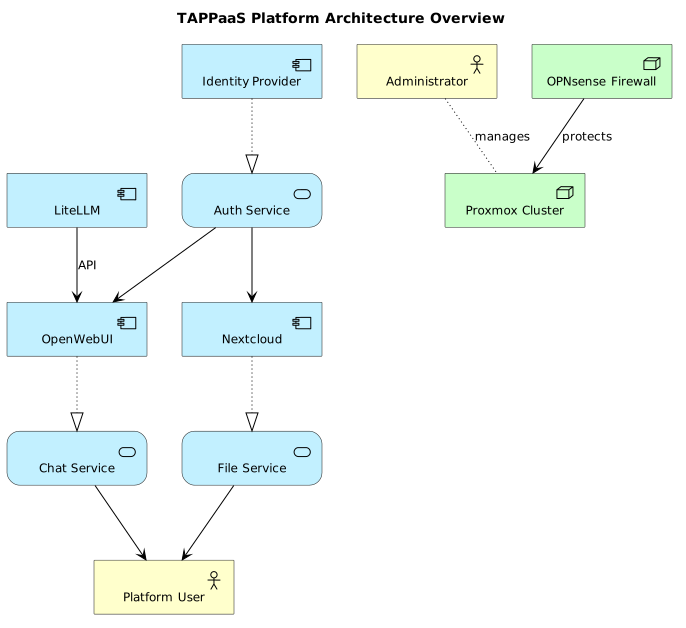
Platform Architecture Overview
The high-level view — users, applications, and infrastructure:
Architecture Layers
- Business layer — the actors (platform users, administrators) and the services they consume (chat, files, workflows).
- Strategy layer — the capabilities, organized into stacks (see Capabilities).
- Application layer — the components realizing the capabilities (see the module catalog under Stacks).
- Technology layer — Proxmox virtualization, OPNsense firewall + Caddy reverse proxy, ZFS storage with replication.
The stack-level ArchiMate views live on the Stacks pages; drawing conventions for diagram authors are in NOTATION.md in the Documentation repository (not published).